
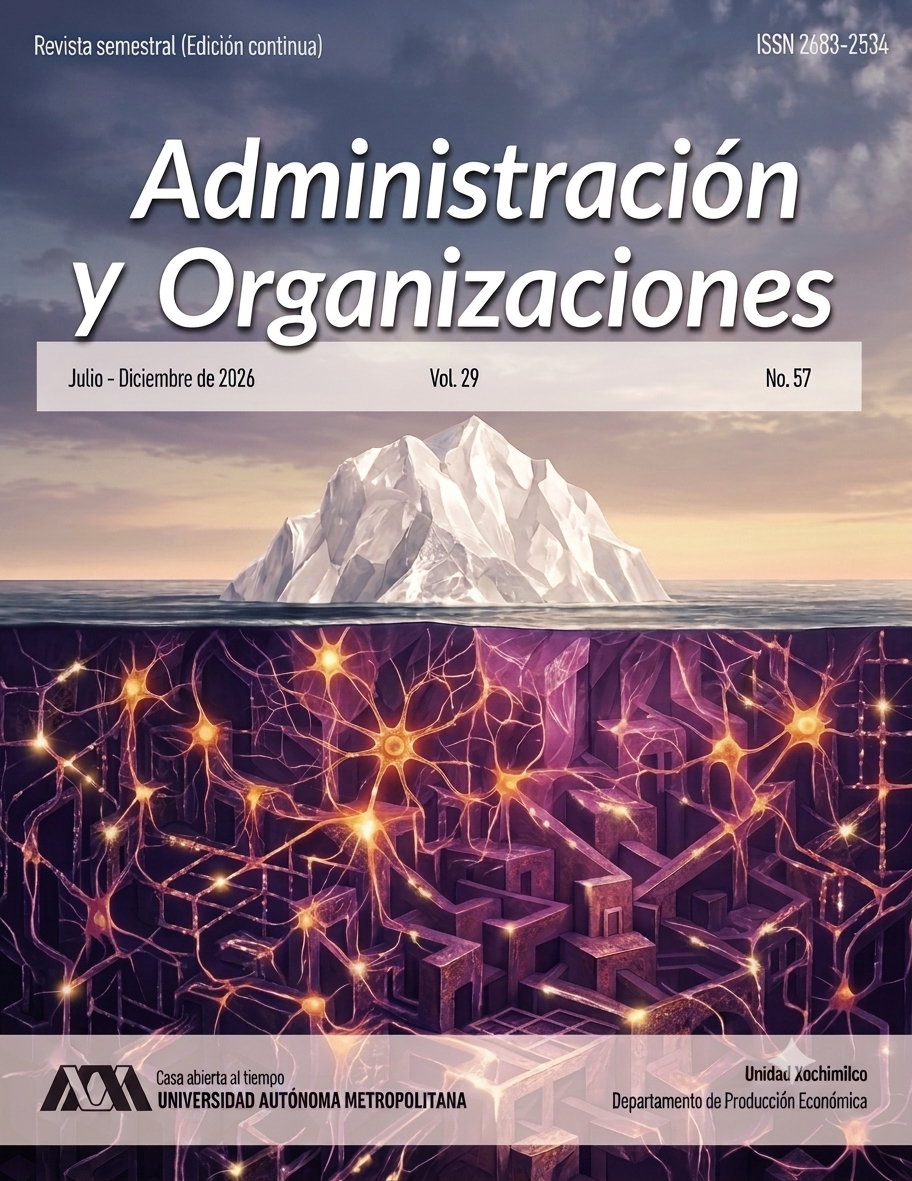
Does bureaucracy threaten firms? A multidimensional analysis of its theory and praxis from its organizational structure
DOI:
https://doi.org/10.24275/BZXJ2724Palabras clave:
organizational structure, management operations, organizational change, organization and managementResumen
In today's administrative praxis, bureaucracy still manifests in firms through its organizational structure, hindering management processes through unperceived and, therefore, unstudied practices. The aim of this research is to identify the theoretical principles of bureaucracy and its theoretical-practical convergence with structuralism and its dimensions in firms. Throughout an exploratory and descriptive study, a documentary review of the significant bureaucratic theory authors and the organizational structure's fundamental researchers was carried out. This comparison made it possible to identify how the dimensions of bureaucracy closely converge with the dimensions of structuralism. This multidimensional analysis bridges the gap between the two theories, enabling organizations to understand the threat posed by bureaucracy and the impact of the main structural dimensions (centralization, formalization, and specialization) on other organizational factors —both formal and informal— while taking into account the contingencies to which their organizational structure is exposed.
Descargas
Citas
Aiken, M., Bacharach, S., & French, L. (1980). Organizational Structure, Work Process, and Proposal Making in Administrative Bureaucracies. Academy of Management Journal, 23(4), 631–652. https://doi.org/10.5465/255553
Aiken, M., & Hage, J. (1966). Organizational Alienation: A Comparative Analysis. American Sociological Review, 31(4), 497–507. https://doi.org/10.2307/2090773
Aiken, M., & Hage, J. (1968). Organizational Interdependence and Intra-Organizational Structure. American Sociological Review, 33(6), 912–930. https://doi.org/10.2307/2092683
Aneta, Y., Akib, H., Padungge, A. W., Pakaya, R., & Hulinggi, P. A. (2025). The Impact of Digital Transformation and Artificial Intelligence on Bureaucratic Culture Between Efficiency and Discretion. KnE Social Sciences, 10(4), 1–20. https://doi.org/10.18502/kss.v10i4.18019
Barba, A., & Montoya, M. (2018). De la planeación al pensamiento estratégico. Aproximación a un debate inconcluso. Administración y Organizaciones, 16(30), 51–77. https://rayo.xoc.uam.mx/index.php/Rayo/article/view/104
Brandtner, C., Powell, W., & Horvath, A. (2024). From Iron Cage to Glass House: Repurposing of bureaucratic management and the turn to openness. Organization Studies, 45(2), 193–221. https://doi.org/10.1177/01708406231200727
Caetano, I. (2017). Standardization and innovation management. Journal of Innovation Management, 5(2), 8–14. https://api.semanticscholar.org/CorpusID:168751097
Child, J. (1984). Organization: A Guide to Problems and Practice (2nd ed.). SAGE Publications Ltd. https://doi.org/10.4135/9781446280348
Coble, D. (1978). The Effect of the Implementation of Comprehensive Planning and Management by Objectives on the Bureaucratization of a School Organization [Tesis de Doctorado, University of North Carolina]. Repositorio Institucional http://libres.uncg.edu/ir/uncg/f/Coble_uncg_7824884.PDF
Cohen, E., & Franco, R. (2017). Evaluación de proyectos sociales (9th ed.). Siglo XXI editores.
Cordes-Berszinn, P. (2013). Dynamic capabilities: How organizational structures affect knowledge processes (1st ed.). Palgrave Macmillan. https://doi.org/10.1057/9781137351289
Daft, R. (1978). A Dual-Core Model of Organizational Innovation. Academy of Management Journal, 21(2), 193–210. https://www.jstor.org/stable/255754
Daft, R. (2011). Organizational Theory and Design (EB Franklin, A. Mirafuentes, and E. Bores (eds.); 10th ed.). Cengage Learning.
Dalton, D., Todor, W., Spendolini, M., Fielding, G., & Porter, L. (1980). Organization Structure and Performance: A Critical Review. Academy of Management Review, 5(1), 49–64. https://doi.org/10.2307/257804
Dewar, R., Whetten, D., & Boje, D. (1980). An Examination of the Reliability and Validity of the Aiken and Hage Scales of Centralization, Formalization, and Task Routineness. Administrative Science Quarterly, 25(1), 120. https://doi.org/10.2307/2392230
Dewar, R., & Dutton, J. (1986). The Adoption of Radical and Incremental Innovations: An Empirical Analysis. Management Science, 32(11), 1422–1433. https://doi.org/10.1287/mnsc.32.11.1422
Domínguez, E., Mallén, F., Lapiedra, R., & Chiva, R. (2020). How to enhance radical innovation? The importance of organizational design and generative learning. Review of Managerial Science, 14(5), 1101–1122. https://doi.org/10.1007/s11846-019-00326-7
Duncan, R. (1976). The ambidextrous organization, designing dual structures for innovation. The Management of Organization Design, 1, 167–188.
Etzioni, A. (1975). A comparative analysis of complex organizations (Revised Ed). Free Press.
Fredrickson, J. (1986). The Strategic Decision Process and Organizational Structure. The Academy of Management Review, 11(2), 280. https://doi.org/10.2307/258460
Gouldner, A. (1964). Patterns of industrial bureaucracy (1st ed.). FreePress.
Hage, J., & Aiken, M. (1967). Program Change and Organizational Properties to Comparative Analysis. American Journal of Sociology, 72(5), 503–519. https://www.jstor.org/stable/2775676
Hall, R. (1962). Intraorganizational Structural Variation: Application of the Bureaucratic Model. Administrative Science Quarterly, 7(3), 295. https://doi.org/10.2307/2390944
Hall, R. (1963). The Concept of Bureaucracy: An Empirical Assessment. American Journal of Sociology, 69(1), 32–40. https://doi.org/10.1086/223508
Hall, R. (1983). Organizaciones: Estructura y proceso (1st ed.). Prentice Hall Internacional.
Hendryadi, Suratna, S., & Purwanto, B. (2019). Bureaucratic culture, empowering leadership, affective commitment, and knowledge sharing behavior in Indonesian government public services. Cogent Business and Management, 6(1), 2–12. https://doi.org/10.1080/23311975.2019.1680099
Hidalgo-Pozzi, R., Alamo-Larrañaga, K., Rojas-Vela, J., Ruiz-Correa, S., Gonzáles-Alegría, L., & Reátegui-Reátegui, M. (2024). Optimización de procesos en la estructura organizacional de los Modelos de Negocio. Revisión sistemática. Bibliotecas. Anales De Investigación, 2(20), 1–12. https://revistasbnjm.sld.cu/index.php/BAI/article/view/852
Hirst, A. & Humphreys, M. (2015). Configurable Bureaucracy and the Making of Modular Man. Organization Studies, 36(11), 1531–1553. https://doi.org/10.1177/0170840615593585
Jansen, J.J.P., Van Den Bosch, F.A.J. & Volberda, H.W. (2006) Exploratory Innovation, Exploitative Innovation, and Performance: Effects of Organizational Antecedents and Environmental Moderators. Management Science, 52, 1661- 1674. http://dx.doi.org/10.1287/ mnsc.1060.0576
Joseph, J., & Gaba, V. (2020). Organizational Structure, Information Processing, and Decision-Making: A Retrospective and Road Map for Research. The Academy of Management Annals, 14(1), 267–302. https://doi.org/10.5465/annals.2017.0103
Katsikea, E., Theodosiou, M., Perdikis, N., & Kehagias, J. (2011). The effects of organizational structure and job characteristics on export sales managers' job satisfaction and organizational commitment. Journal of World Business, 46(2), 221–233. https://doi.org/10.1016/j.jwb.2010.11.003
Kortmann, S. (2012). The Relationship between Organizational Structure and Organizational Ambidexterity: A Comparison between Manufacturing and Service Firms (1st ed.). Gabler Verlag. https://doi.org/10.1007/978-3-8349-3630-1
Leso, B. H., Cortimiglia, M. N., & Ghezzi, A. (2023). The contribution of organizational culture, structure, and leadership factors in the digital transformation of SMEs: a mixed-methods approach. Cognition, Technology & Work, 25(1), 151–179. https://doi.org/10.1007/s10111-022-00714-2
Madero G. S., & Barboza, G. A. (2015). Interrelación de la cultura, flexibilidad laboral, alineación estratégica, innovación y rendimiento empresarial. Contaduría y Administración, 60(4), 735–756. https://doi.org/10.1016/J.CYA.2014.08.001
Medina, M., & Ávila, V. (2002). Evolución de la teoría administrativa. Una visión desde la psicología organizacional. Revista Cubana de Psicología, 19(3), 262–272.
Merton, R. (1968). Social Theory and Social Structure (Enlarged). Free Press / Collier MacMillan.
Mintzberg, H. (2005). Structuring Organizations (8th ed.). Ariel.
Monteiro, P., & Adler, P. S. (2021). Bureaucracy for the 21st Century: Clarifying and Expanding Our View of Bureaucratic Organization. SSRN Electronic Journal. https://doi.org/10.2139/ssrn.4008916
Mustafa, G., Solli-Sæther, H., Bodolica, V., Håvold, J. I., & Ilyas, A. (2022). Digitalization trends and organizational structure: bureaucracy, ambidexterity or post-bureaucracy? Eurasian Business Review, 12(4), 671–694. https://doi.org/10.1007/s40821-021-00196-8
Nair, N., & Vohra, N. (2010). An exploration of factors predicting work alienation of knowledge workers. Management Decision, 48(4), 600–615. https://doi.org/10.1108/00251741011041373
Palafox M. (2025). Estructura organizacional a través de las teorías administrativas. Global Business Administration Journal, 9(1), 1. https://doi.org/10.31381/gbaj.v9i1.6448
Pierce, J., & Delbecq, A. (1977). Organization Structure, Individual Attitudes and Innovation. The Academy of Management Review, 2(1), 27. https://doi.org/10.2307/257602
Pugh, D., Hickson, D., Hinings, C, & Turner, M. (1968). Dimensions of Organization Structure. Administrative Science Quarterly, 13(1), 65. https://doi.org/10.2307/2391262
Reimann, B. (1974). Dimensions of Structure in Effective Organizations: Some Empirical Evidence. Academy of Management Journal, 17(4), 693–708. https://doi.org/10.5465/255647
Selznick, P. (2015). TVA and the Grass Roots: a study in the sociology of formal organization. QuidPro, LLC.
Udy, S. (1959). "Bureaucracy" and "Rationality" in Weber's Organization Theory: An Empirical Study. American Sociological Review, 24(6), 791. https://doi.org/10.2307/2088566
Weber, M. (2002). Economía y Sociedad (2nd ed.). Fondo de Cultura Económica.
Zapata, G., & Sigala, L. (2010). Tipología de la especialización del trabajo en la organización: Fundamentos para su propuesta. Visión Gerencial, 2, 430–442. https://api.semanticscholar.org/CorpusID:192081936
Descargas
Publicado
Cómo citar
Número
Sección
Licencia
Derechos de autor 2026 Administración y Organizaciones

Esta obra está bajo una licencia internacional Creative Commons Atribución-NoComercial-SinDerivadas 4.0.
Es responsabilidad de los autores garantizar que los manuscritos enviados a Administración y Organizaciones sean originales, que no hayan sido publicados y no estén considerados para su publicación en otra revista. Como parte de una política de la revista, todos los manuscritos recibidos serán sometidos al software iThenticatev para identificar que las fuentes utilizadas fueron citadas de manera correcta y asegurar que los artículos sean originales e inéditos, aquellos artículos que tengan párrafos clonados de otras fuentes no continuarán con el proceso de dictaminación.
El lector es libre de compartir o adaptar el material en cualquier medio o formato bajo las condiciones siguientes: (1) debe reconocer adecuadamente la autoría, proporcionar un enlace a la licencia e indicar si se han realizado cambios; (2) no puede utilizar el material para una finalidad comercial y (3) si remezcla, transforma o crea a partir del material, deberá difundir sus contribuciones bajo la misma licencia que el original.
Cada autor es responsable del contenido de su artículo. En el caso de un texto colectivo, el primer autor asume la responsabilidad intelectual de los resultados del proceso editorial; los autores son responsables de obtener la licencia de autor para reproducir materiales gráficos o fotográficos que pertenecen a terceros.
Los autores asumen plena responsabilidad en el caso de falsificación de datos o falta de autenticidad en la investigación. Se comprometen, también, a no reutilizar trabajos ya publicados, total o parcialmente, para presentarlos en otra publicación.
Aceptado 2026-06-15
Publicado 2026-07-28